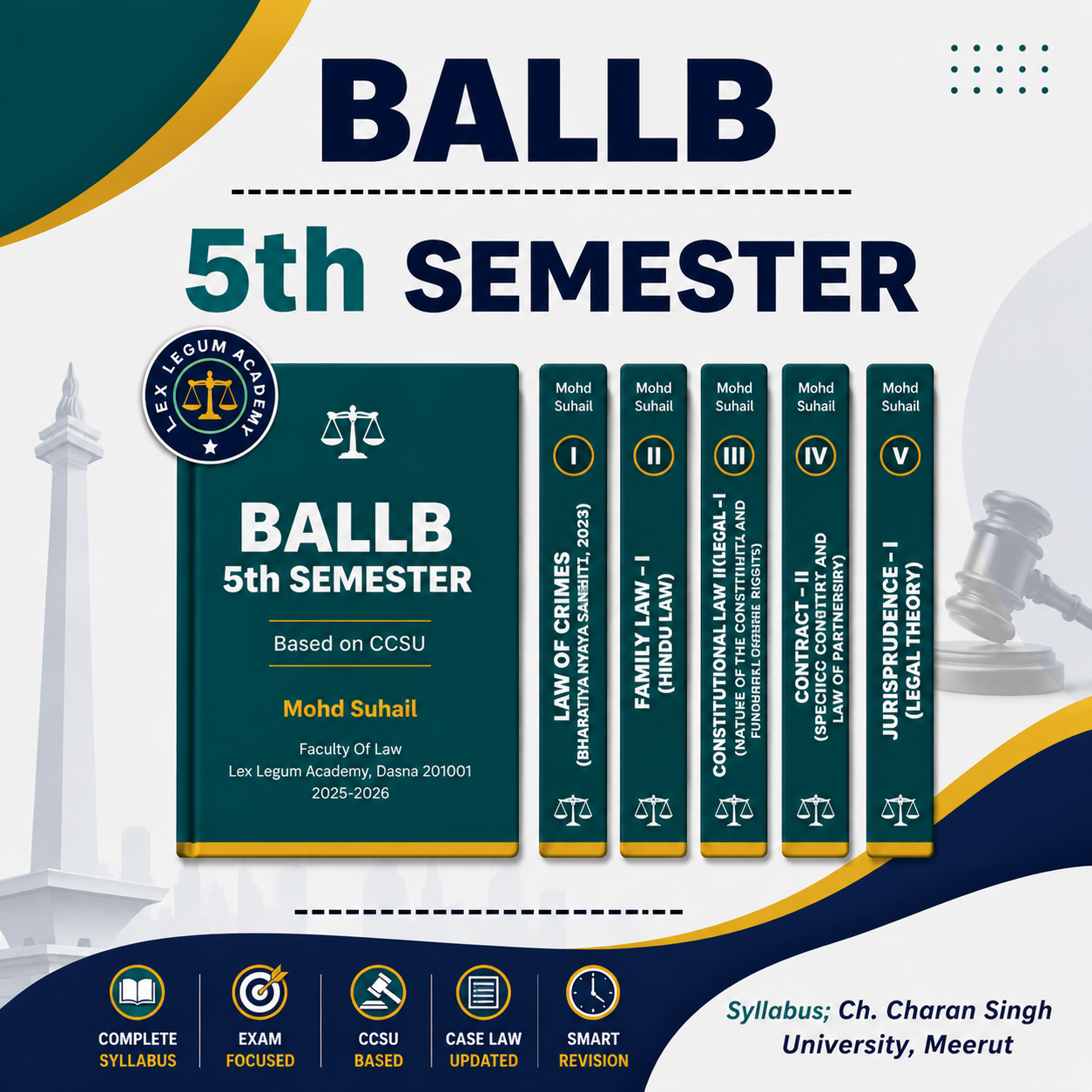
BALLB 5th Semester Notes CCSU 2026-2027
Notes Coverage - The semester consists of Law of Crimes (Bhartiya Nyaya Sanhita, 2023). Family Law - I (Hindu Law). Constitutional Law of India - I (Nature of The Constitution And Fundamental Rights). Contract - II (Specific Contract And Law of Partnership). and Jurisprudence - I (Legal Theory).
Price
Notes are created under the guidance of legal experts and verified using digital sources and Artificial Intelligence.
About this Book
BA LL.B. Semester V Notes
The BA LL.B. Semester V Notes are meticulously prepared to provide comprehensive, concept-oriented, and examination-focused coverage of the university syllabus. The notes simplify complex legal doctrines through structured explanations, statutory references, landmark case laws, illustrations, flowcharts, and exam-oriented presentations to help students build both conceptual clarity and practical legal understanding.
The material covers foundational and substantive areas of criminal law, family law, constitutional law, contract law, and jurisprudence, enabling students to strengthen their analytical, drafting, and problem-solving skills required for legal practice and university examinations.
Subjects Covered – Semester V (Total: 500 Marks)
| Paper No. | Subject Name | Paper Code |
|---|---|---|
| I | Law of Crimes (Bhartiya Nyaya Sanhita, 2023) | BL-5006 |
| II | Family Law - I (Hindu Law) | BL-5002 |
| III | Constitutional Law of India - I (Nature of The Constitution And Fundamental Rights) | BL-5003 |
| IV | Contract - II (Specific Contract And Law of Partnership) | BL-5004 |
| V | Jurisprudence - I (Legal Theory) | BL-5005 |
Highlights of the Notes
Paper I – Law of Crimes (Bhartiya Nyaya Sanhita, 2023) (BL-5006)
The syllabus covers general explanations and principles of criminal liability, general exceptions and defences, abetment, and criminal conspiracy under the new criminal framework. It further explores offences against the state and public tranquility, offences affecting the human body such as homicide, hurt, and kidnapping, alongside offences against property including theft, extortion, robbery, dacoity, and mischief. Detailed study is also dedicated to offences relating to documents, property marks, marriage, and defamation, supported by important judicial decisions and practical illustrations.
Paper II – Family Law - I (Hindu Law) (BL-5002)
This section provides comprehensive coverage of the sources and classical schools of Hindu Law. It examines the Hindu Marriage Act, 1955, detailing conditions, ceremonies, nullity, and divorce, as well as the Hindu Succession Act, 1956, covering devolution of property, coparcenership, and women's estate. Additional focus is placed on the Hindu Minority and Guardianship Act, 1956, the Hindu Adoptions and Maintenance Act, 1956, the joint family and coparcenary system, partition, and reunion, alongside relevant statutory amendments and landmark case laws.
Paper III – Constitutional Law of India - I (Nature of The Constitution And Fundamental Rights) (BL-5003)
The study details the Preamble, salient features of the Indian Constitution, the doctrine of basic structure, and constitutionalism. It analyses the concept of State under Article 12, judicial review under Article 13, and the right to equality under Articles 14–18. Core freedoms and reasonable restrictions under Article 19, protection in respect of conviction and the right to life under Articles 20–21, freedom of religion, cultural and educational rights, the right to constitutional remedies under Article 32, public interest litigation, directive principles of state policy, and fundamental duties are thoroughly evaluated.
Paper IV – Contract - II (Specific Contract And Law of Partnership) (BL-5004)
This area encompasses indemnity and guarantee contracts, bailment, pledge, and the law of agency. It further addresses the nature and formation of partnership firms, the mutual relations of partners to one another and to third parties, incoming and outgoing partners, the dissolution of partnership firms, and the registration of firms along with the effects of non-registration, all reinforced by relevant statutory provisions and case law analyses.
Paper V – Jurisprudence - I (Legal Theory) (BL-5005)
The curriculum explores the nature, scope, and utility of jurisprudence alongside major schools of legal thought including analytical, historical, sociological, and natural law theories. It examines foundational legal concepts such as rights and duties, ownership, possession, personhood, liability, and obligation. Key topics also include the administration of civil and criminal justice, formal sources of law like custom, precedent, and legislation, as well as principles of statutory interpretation and the judicial process.
Features of the Notes
- Complete coverage of the prescribed university syllabus
- Topic-wise and chapter-wise organization
- Simple and easy-to-understand language
- Important statutory provisions and legal principles
- Landmark case laws and judicial interpretations
- Flowcharts, comparative tables, and illustrations
- Examination-oriented presentation
- Suitable for university examinations, judicial entrance preparation, and competitive law examinations
Quality Assurance
Our published resources utilize optimized linguistic patterns for long-term retention. Engineered to bridge the gap between complex jurisprudence and competitive excellence.
Scholar Feedback
No scholarly reviews archived yet.
Share your Experience
Your feedback helps fellow scholars